Alice Marquis
The Pale Blue EyeAlice Marquis is the socially expansive but difficult-to-read matriarch of the Marquis household. As wife to Dr. Daniel Marquis and mother to Artemus Marquis and Lea Marquis, she presides over a home where comic performance, family strain, and efforts to direct Lea’s future repeatedly meet. Augustus Landor’s accounts show her shifting abruptly from welcoming hostess to apparent crisis and back again, leaving the meaning of those shifts unresolved.
Identity and Presence
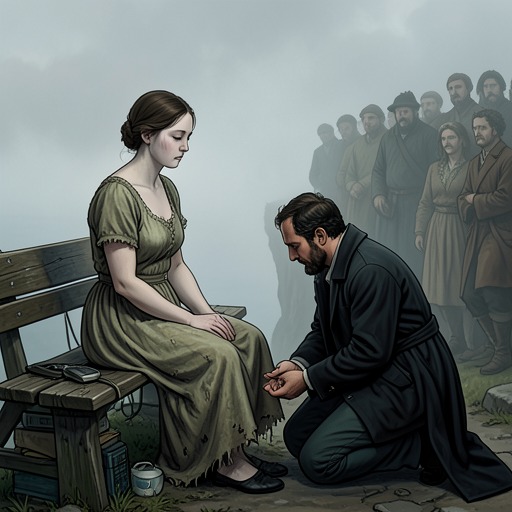
Landor first encounters Alice at her residence, where she comes into the foyer in a black crepe mourning dress, her hands fluttering as she hurries to welcome him out of the cold. Her face initially appears rigid and chilled; the narrator’s animal imagery makes her seem at once physically slight and theatrically expressive. She takes Landor by the elbow and ushers him inside, then turns her attention to Edgar Allan Poe, whom she treats as if newly arrived despite his already being there. Her welcome is generous and performative: she praises Poe’s gallantry and poetic ear, then complains that Artemus is late and declares that she can entertain her two guests herself.
Alice’s domestic manner is bound up with display. At dinner, after Artemus questions whether he understands her meaning, she looks toward Daniel and drops her plate. Food and china scatter across the table. She immediately redirects the outburst into anger at Eugenie, the servant, railing about the difficulty of finding household help and insisting that the time has come to resist being treated poorly. She then rises, clutching her hair, and leaves the room with her napkin still pinned to her dress. The episode is both a conspicuous eruption and an abrupt exit; the account supplies no single explanation that settles what lies behind it.
Family and Household
Alice’s exchange with Daniel gives the dinner episode its intimate undertone. Before the plate falls, the two look at one another across the table with a depth of feeling that makes the physical distance between them seem to disappear. The contrast between that silent closeness and Alice’s public, escalating complaint leaves their private understanding more palpable than explicit.
She reappears carrying a taper and claims that the spell she had feared was a migraine has passed after a brief rest. Rather than allow the interrupted moment to develop, she manages the return downstairs: Daniel is told to put away his journal article, Landor is asked to remove the old military coat, and Daniel is asked to extinguish the parlor fire. Her practical instructions restore the appearance of an ordinary evening. Outside the room, however, Landor hears the pianoforte and hurried feet: Lea is playing a quadrille while Poe and Artemus dance and laugh. Alice calls out that she wants to play too, joining the sudden release of high spirits without explaining her earlier departure.
Plans for Lea
In conversation with Landor, Alice presents Lea as a desirable match who has remained unmarried because she is particular and full of ideas. She argues that her daughter would be better suited to a man of more mature sensibilities, someone who could guide her toward what Alice regards as her proper place in life. When Landor suggests that Lea herself should judge, Alice invokes her own younger self as a reason to trust a mother’s judgment. She favors an older man, specifically a widower, and punctuates the suggestion by tapping Landor’s cuff link twice. The gesture makes the matchmaking personal: Alice is not merely discussing an abstract ideal but directing Landor’s attention toward himself as a possible candidate.
Narrative Significance
Alice’s appearances are marked by reversals of tone: hospitality becomes agitation, apparent distress gives way to brisk management, and a tense dinner is followed by music and dancing. The shifts make the Marquis home seem at once convivial and unstable, while Alice’s wish to direct Lea’s romantic prospects exposes the pressure she places on her daughter’s choices. Yet the account does not resolve her motives or explain her sudden episodes; her character remains legible through the contrast between what she does in public and what the household’s silences leave unsaid.